
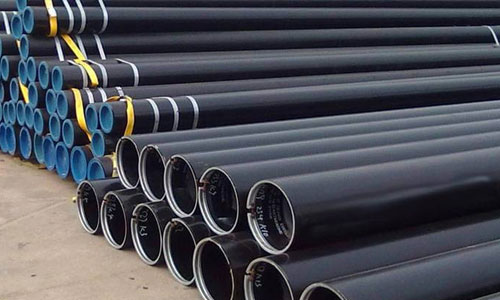
Carbon Steel Pipes: A Complete Guide
Carbon steel pipes are the backbone of industrial piping — moving oil, gas, water, steam, and chemicals across power plants, refineries, pipelines, and construction sites. They earn their place through a rare combination of strength, affordability, and easy availability. This guide breaks down what they are, the types and grades you’ll meet, how sizing works, and how to choose the right pipe for your job.
What Are Carbon Steel Pipes?
A carbon steel pipe is a tubular product made from an alloy of iron and carbon, with small amounts of manganese, silicon, and trace elements. Carbon is the defining ingredient: most pipe-grade steels carry between 0.05% and 0.30% carbon, and that level controls the balance between strength and workability.
More carbon means higher strength and hardness but lower ductility and weldability. Less carbon makes the pipe easier to bend, weld, and form. Because they contain no significant chromium or nickel, carbon steel pipes are not naturally corrosion-resistant — so they’re usually coated, galvanized, or lined when exposed to moisture or aggressive media.
They’re produced either seamless (extruded with no joint) or welded (formed from rolled plate or strip), and are used to carry fluids and gases, often under high pressure and temperature.
Types of Carbon Steel Pipes
Carbon steel pipes are grouped two ways — by how they’re manufactured, and by how much carbon they contain.
By Manufacturing Method
- Seamless (SMLS): Made from a solid billet pierced and drawn into a tube. No weld seam means uniform strength and the highest pressure ratings — ideal for high-pressure and high-temperature service.
- ERW (Electric Resistance Welded): Formed from steel strip and fused along a longitudinal seam. Cost-effective and consistent for small-to-medium diameters.
- LSAW (Longitudinal Submerged Arc Welded): Large-diameter pipe welded along a straight seam — common in oil and gas transmission lines.
- SSAW / HSAW (Spiral Welded): Strip wound and welded in a spiral seam. Economical for large diameters in water, piling, and structural use.
By Carbon Content
- Low / mild carbon (< 0.30%): The most common piping steel — ductile, highly weldable, and versatile.
- Medium carbon (0.30–0.60%): Stronger and harder, used where extra mechanical strength is needed.
- High carbon (> 0.60%): Very strong but hard to weld and form — rarely used for standard piping.
Common Carbon Steel Pipe Grades
Grades are defined by international standards (ASTM, ASME, API) that specify chemistry, mechanical properties, and testing. Here are the grades you’ll encounter most often:
| Grade | Standard | Type | Key Features | Common Applications |
|---|---|---|---|---|
| A53 Gr A/B | ASTM A53 | Seamless / Welded | General purpose, can be galvanized | Water, air, steam, low-pressure gas |
| A106 Gr A/B/C | ASTM A106 | Seamless | High-temperature service | Power plants, refineries, boilers |
| API 5L (B, X42–X70) | API 5L | Seamless / Welded | Pipeline transmission grades | Oil & gas pipelines |
| A333 Gr 6 | ASTM A333 | Seamless / Welded | Low-temperature toughness | Cryogenic & cold-climate lines |
| A179 | ASTM A179 | Seamless (cold drawn) | Smooth bore, tight tolerances | Heat exchangers, condensers |
| A210 Gr A1/C | ASTM A210 | Seamless | Boiler & superheater service | Boiler & superheater tubes |
Always confirm the grade against your project specification, design code, and required material certification (e.g. mill test certificate / EN 10204 3.1).
Carbon Steel Pipe Sizes & Schedules
Pipe size is described by NPS (Nominal Pipe Size) and a Schedule (SCH). For a given NPS the outside diameter (OD) stays fixed, while the schedule sets the wall thickness — a higher schedule means a thicker wall and a higher pressure rating. Common schedules run SCH 5, 10, 40, 80, 160, and XXS.
| NPS | OD (mm) | SCH 40 Wall (mm) | SCH 80 Wall (mm) |
|---|---|---|---|
| 1/2″ | 21.3 | 2.77 | 3.73 |
| 3/4″ | 26.7 | 2.87 | 3.91 |
| 1″ | 33.4 | 3.38 | 4.55 |
| 1.1/2″ | 48.3 | 3.68 | 5.08 |
| 2″ | 60.3 | 3.91 | 5.54 |
| 3″ | 88.9 | 5.49 | 7.62 |
| 4″ | 114.3 | 6.02 | 8.56 |
| 6″ | 168.3 | 7.11 | 10.97 |
| 8″ | 219.1 | 8.18 | 12.70 |
Dimensions follow ASME B36.10M. Wall thicknesses vary by schedule; verify exact values for your selected NPS and SCH before ordering.
Advantages of Carbon Steel Pipes
- High strength & pressure capacity: Handles demanding pressures and mechanical loads.
- Cost-effective: Significantly cheaper than stainless or alloy steel for comparable strength.
- Durability: Long service life and excellent resistance to shock and vibration.
- Weldable & machinable: Low-carbon grades are easy to weld, cut, thread, and fabricate on site.
- Wide availability: Standardized worldwide and stocked in a huge range of sizes and grades.
- Recyclable: Fully recyclable, supporting more sustainable projects.
- Versatile: Performs across a broad range of temperatures and applications.
Note: carbon steel is prone to corrosion, so protective coatings, galvanizing, or internal linings are recommended in wet or corrosive environments.
How to Select the Right Carbon Steel Pipe
Choosing the correct pipe comes down to matching the material and dimensions to your operating conditions. Work through these factors:
- Application & medium: Identify what the pipe will carry — water, steam, gas, oil, or chemicals.
- Pressure & temperature: These drive your choice of grade and schedule (wall thickness).
- Corrosion environment: Decide on coatings, linings, or a higher-spec material if conditions are aggressive.
- Size & schedule: Select the NPS for flow needs and the schedule for pressure rating.
- Standard & certification: Match the grade to your project code (ASTM/ASME/API) and required test certificates.
- Manufacturing type: Choose seamless for high pressure, welded for cost efficiency at larger sizes.
- Budget & availability: Balance specification against lead time and stock.
Conclusion
Carbon steel pipes remain a first-choice material across industry because they deliver strength, reliability, and value in equal measure. By understanding the available types, grades, and sizing systems — and weighing your application, pressure, temperature, and environment — you can specify a pipe that performs safely for years.
If you’re unsure which grade or schedule fits your project, talk to a trusted supplier who can match the right pipe to your exact requirements and provide proper material certification.