



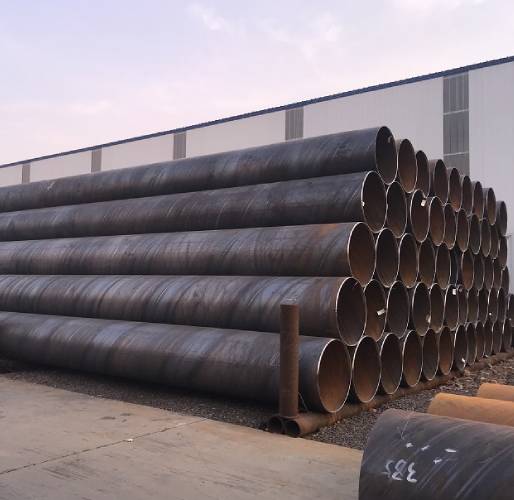
What is LSAW Pipe?
LSAW pipe means Longitudinal Submerged Arc Welded pipe. It is a type of steel pipe we make from flat steel plate. A single straight weld seam runs the entire length. The manufacturing process involves forming the plate into a cylindrical shape. We use JCOE (J-forming, C-forming, O-forming, Expanding) or UOE (U-forming, O-forming, Expanding) techniques. The longitudinal seam is welded using submerged arc welding from both inside and outside surfaces. This creates a strong double-sided weld joint. These pipes have high dimensional accuracy. They have tighter tolerances. LSAW pipes provide high pressure ratings and good structural integrity. They are for high-pressure transmission of oil, gas, and other fluids. Weld quality is the main priority here.
LSAW Pipe Manufacturing Process
The LSAW pipe manufacturing process is very systematic. We produce high-quality pipes for heavy-duty use.
- Steel plate inspection and edge preparation to check material quality
- Edge milling and beveling for the weld joint
- J-forming process to crimp the plate edges
- C-forming to create a partial cylindrical shape
- O-forming to finish the pipe body
- Tack welding to hold the seam
- Inside submerged arc welding (ID SAW)
- Outside submerged arc welding (OD SAW)
- Mechanical expansion (E) to get final dimensions and relieve residual stress
- NDT inspection including ultrasonic and radiographic testing
- Hydrostatic testing and end finishing
- Coating application
LSAW vs SSAW Pipe - Comparison
We often see a gap between what people know about LSAW and HSAW pipes. This table shows the difference between LSAW and HSAW pipes and helps you choose.
| Feature | LSAW Pipe | SSAW Pipe |
|---|---|---|
| Weld Direction | Longitudinal (Straight) | Spiral / Helical |
| Raw Material | Steel Plate | Steel Coil |
| Diameter Range | 16" – 60" | 20" – 100"+ |
| Pressure Rating | Higher | Moderate |
| Cost | Higher | Lower |
| Applications | High-pressure pipelines | Water transmission, piling |
LSAW Pipe Specifications
The following LSAW pipe specification, like standards, grades, dimensions, and coating options, details our range:
| Standards | API 5L PSL1 / PSL2, ASTM A672, ASTM A691 |
|---|---|
| Grades | B, X42, X46, X52, X56, X60, X65, X70, X80 |
| OD Range | 406 mm – 1524 mm (16" – 60") |
| Wall Thickness | 6 mm – 40 mm |
| Length | 6 m – 18 m |
| Coating Options | Bare, 3LPE, FBE, Epoxy |
Applications
LSAW pipe applications are for critical work. They need high pressure ability. It is found in 3 major industries:
Testing & Certification
Every pipe goes through tough testing. We want to ensure they meet the standards.
- 100% Ultrasonic Testing (UT) of weld seam and body
- Radiographic Testing (RT) per API 5L requirements
- Hydrostatic Testing to verify pressure integrity
- API 5L Monogram certification for qualified products
Frequently Asked Questions
-
What does LSAW stand for?
LSAW stands for Longitudinal Submerged Arc Welded pipe. This means the weld seam runs lengthwise. We use the submerged arc welding process on both the inside and outside surfaces. -
What is the maximum wall thickness of LSAW pipe?
The maximum wall thickness of LSAW pipe is up to 40 mm or more depending on the pipe diameter and grade requirements.