



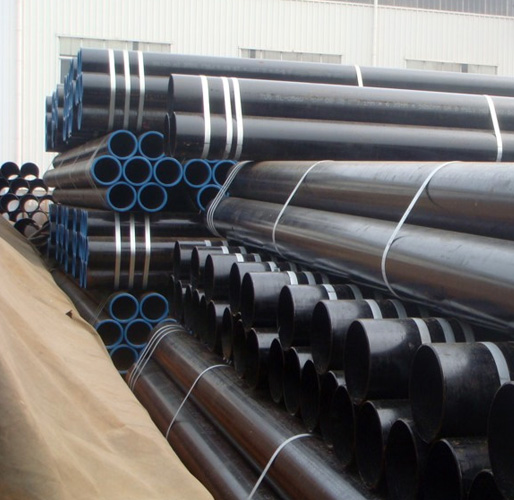
What are Grades 1050/1055?
Grades 1050 and 1055 are high-carbon steels at the upper limit of plain carbon grades. These ASTM A519 1050 1055 tubes are used where wear resistance and spring properties are needed. They get their high hardness from heat treatment. Grade 1050 is a high-carbon grade that has versatile applications. It has 0.48–0.55% carbon. As it has great fatigue strength, grade 1055 with 0.50–0.60% carbon is often used for springs.
ASTM A519 Grade 1050, 1055 Tube Specifications
To ensure proper material selection for high-hardness applications, refer to the ASTM A519 Grade 1050 and 1055 tube specifications detailed below:
| Standard | ASTM A519 / ASME SA 519 |
|---|---|
| Grade | 1050, 1055 |
| UNS Number | G10500, G10550 |
| Manufacturing Type | Seamless Hot Finished / Cold Drawn |
| Conditions | HR (Hot Rolled), CD (Cold Drawn), SR (Stress Relieved), QT (Quenched & Tempered) |
| Outside Diameter (OD) | Up to 1800 mm |
| Wall Thickness | Up to 250 mm |
| Length | Single Random, Double Random, Cut Length |
| Form | Round, Square, Rectangular, Special Sections |
ASTM A519 Grade 1050, 1055 Tube Chemical Composition
The following table outlines the chemical composition requirements for ASTM A519 Grade 1050 and 1055 high-carbon steel tubing:
| Grade | Carbon (C) % | Manganese (Mn) % | Phosphorus (P) % | Sulfur (S) % |
|---|---|---|---|---|
| 1050 | 0.48 - 0.55 | 0.60 - 0.90 | 0.040 max | 0.050 max |
| 1055 | 0.53 - 0.60 | 0.60 - 0.90 | 0.040 max | 0.050 max |
ASTM A519 Grade 1050, 1055 Tube Mechanical Properties
The following table presents the mechanical properties for ASTM A519 Grade 1050 and 1055 in different heat treatment conditions:
| Tensile Strength | Yield Strength | Elongation | Hardness (HBW) | Impact Strength |
|---|---|---|---|---|
| 620 – 760 MPa | 350 – 460 MPa | 10 – 20% | 167 – 217 | Good (varies by heat treatment) |
Heat Treatment
ASTM A519 Grade 1050 and 1055 require precise heat treatment control to achieve high hardness without cracking. The critical parameters are outlined below:
- Anneal: 790-845°C (1450-1550°F), slow cool
- Normalise: 845-900°C (1550-1650°F)
- Harden: 800-845°C (1475-1550°F), water or oil quench
- Temper: 200-540°C (400-1000°F)
Warning: Susceptible to quench cracking. Uniform heating and proper quench technique are essential.
Welding Considerations
Welding is difficult and generally not recommended for these high-carbon grades due to the following reasons:
- Very high carbon equivalent
- High crack sensitivity
If welding is required:
- Preheat 260-315°C (500-600°F)
- Use low-hydrogen electrodes
- Post-weld heat treatment is mandatory
- Consider mechanical fastening alternatives
Applications
The ASTM A519 1050 and A519 1055 tubes serve 3 applications that require high hardness and wear resistance:
Frequently Asked Questions
-
What is the maximum hardness of 1050/1055?
ASTM A519 1050 can achieve HRC 58 maximum, and A519 1055 can reach HRC 62.