



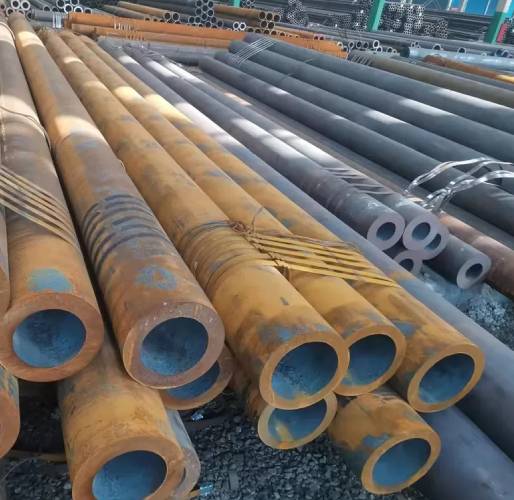
What is Heavy Wall MS Pipe?
Heavy wall MS pipe has wall thickness exceeding standard schedules. This gives higher pressure ratings and better load-bearing capacity for demanding applications. The outside diameter stays the same as standard pipe. Only the wall gets thicker, which reduces the inside diameter.
There are two main reasons why heavy wall thickness pipes are important. They provide a higher internal pressure. The thicker wall contains more force before failing. These pipes also support heavier external loads. Structural columns and supports need material that will not buckle or bend under weight.
However, heavy wall pipe weighs more per metre than standard pipe. This increases the price of the pipe too. But when the application demands it, there is no substitute for adequate wall thickness. Under-specifying the pipe leads to failure. Failure costs far more than the extra material.
Wall Thickness Classes
Indian and international standards define wall thickness differently. Here is how they compare:
IS 1239 Classes (Indian Standard):
- Light (L): Thinnest wall, for low-pressure and structural use
- Medium (M): Standard wall for general water and gas applications
- Heavy (H): Thickest wall for higher pressure and demanding service
ASTM/ASME Schedules:
- SCH 40 (STD): Standard weight, equivalent to IS 1239 Medium
- SCH 80 (XS): Extra strong, roughly equivalent to IS 1239 Heavy
- SCH 120: Heavier than SCH 80, for higher pressure service
- SCH 160: Even heavier, approaching maximum for carbon steel
- XXS (Double Extra Strong): Maximum standard wall thickness
Applications
Heavy wall MS pipes are used in 2 major applications where standard thickness isn't enough: