



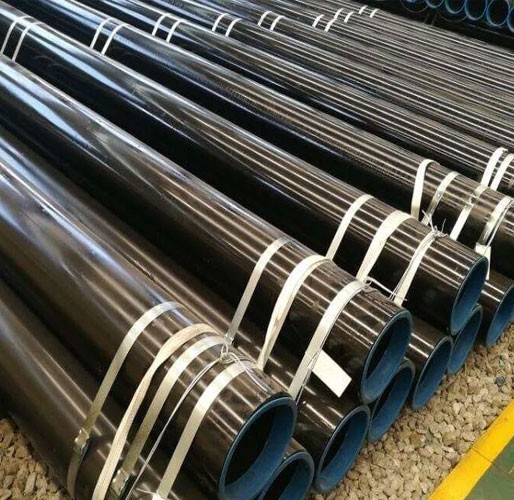
What is API 5L Grade B Pipe?
API 5L Grade B (L245) is a carbon steel line pipe specification. People use it for oil and gas systems. It is the most common grade for general pipelines. It blends strength and weldability well. The "B" means it has a minimum yield strength of 241 MPa (35 ksi). This api 5l grade b pipe works for cross-country lines and gathering systems. It holds pressure. It fits petroleum transport needs perfectly. Apart from this, it maintains the dimensions needed for gas transport.
What is the Difference Between API 5L Grade B PSL1 and PSL2?
API 5L defines two product specification levels with distinct quality requirements. PSL2 pipes undergo more stringent testing and have tighter tolerances than PSL1, making them suitable for critical service applications.
| Feature | PSL1 | PSL2 |
|---|---|---|
| Carbon Equivalent | Not specified | CE ≤ 0.43% |
| Impact Testing | Not required | Required |
| NDT | Weld seam only | Body + weld |
| Traceability | Heat number | Full traceability |
| Applications | General service | Sour service, offshore |
API 5L GR B Pipe Specification
The API 5L GR B pipe specification defines the technical requirements for line pipe used in petroleum and natural gas transportation.
| Standard | API 5L / ISO 3183 |
|---|---|
| Grades | B (L245) |
| Yield Strength | 241 MPa (35 ksi) minimum |
| Tensile Strength | 414 MPa (60 ksi) minimum |
| Elongation | Per API 5L Table 7 |
Delivery Condition
API 5L Grade B pipes are delivered in various heat treatment conditions based on the manufacturing method.
| PSL | Delivery Condition | Pipe grade |
|---|---|---|
| PSL1 | As-rolled, normalized, normalizing formed | A |
| As-rolled, normalizing rolled, thermomechanical rolled, thermo-mechanical formed, normalizing formed, normalized, normalized and tempered or if agreed Q&T SMLS only | B | |
| As-rolled, normalizing rolled, thermomechanical rolled, thermo-mechanical formed, normalizing formed, normalized, normalized and tempered | X42, X46, X52, X56, X60, X65, X70 | |
| PSL 2 | As-rolled | BR, X42R |
| Normalizing rolled, normalizing formed, normalized or normalized and tempered | BN, X42N, X46N, X52N, X56N, X60N | |
| Quenched and tempered | BQ, X42Q, X46Q, X56Q, X60Q, X65Q, X70Q, X80Q, X90Q, X100Q | |
| Thermomechanical rolled or thermomechanical formed | BM, X42M, X46M, X56M, X60M, X65M, X70M, X80M | |
| Thermomechanical rolled | X90M, X100M, X120M | |
| The suffice (R, N, Q or M) for PSL2 grades, belongs to the steel grade |
Chemical Requirements
Chemistry changes between PSL1 and PSL2. PSL2 has tighter carbon equivalent limits. This helps with welding. We keep the mix precise.
Chemical Composition for PSL 1 Pipe with t ≤ 0.984"
PSL1 chemical requirements for Grade B pipe with wall thickness up to 25mm.
| Steel Grade | Mass fraction, % based on heat and product analyses a,g | ||||||
|---|---|---|---|---|---|---|---|
| C | Mn | P | S | V | Nb | Ti | |
| max b | max b | max | max | max | max | max | |
| Seamless Pipe | |||||||
| A | 0.22 | 0.90 | 0.03 | 0.03 | – | – | – |
| B | 0.28 | 1.20 | 0.03 | 0.03 | c,d | c,d | d |
| X42 | 0.28 | 1.30 | 0.03 | 0.03 | d | d | d |
| X46 | 0.28 | 1.40 | 0.03 | 0.03 | d | d | d |
| X52 | 0.28 | 1.40 | 0.03 | 0.03 | d | d | d |
| X56 | 0.28 | 1.40 | 0.03 | 0.03 | d | d | d |
| X60 | 0.28 e | 1.40 e | 0.03 | 0.03 | f | f | f |
| X65 | 0.28 e | 1.40 e | 0.03 | 0.03 | f | f | f |
| X70 | 0.28 e | 1.40 e | 0.03 | 0.03 | f | f | f |
| Welded Pipe | |||||||
| A | 0.22 | 0.90 | 0.03 | 0.03 | – | – | – |
| B | 0.26 | 1.20 | 0.03 | 0.03 | c,d | c,d | d |
| X42 | 0.26 | 1.30 | 0.03 | 0.03 | d | d | d |
| X46 | 0.26 | 1.40 | 0.03 | 0.03 | d | d | d |
| X52 | 0.26 | 1.40 | 0.03 | 0.03 | d | d | d |
| X56 | 0.26 | 1.40 | 0.03 | 0.03 | d | d | d |
| X60 | 0.26 e | 1.40 e | 0.03 | 0.03 | f | f | f |
| X65 | 0.26 e | 1.45 e | 0.03 | 0.03 | f | f | f |
| X70 | 0.26e | 1.65 e | 0.03 | 0.03 | f | f | f |
Chemical Composition for PSL 2 Pipe with t ≤ 0.984"
PSL2 adds a carbon equivalent limit of 0.43% or less. This improves toughness and welding. It makes the pipe safer.
| Steel Grade | Mass fraction, % based on heat and product analyses | Carbon Equiv a | |||||||||||||||||||
|---|---|---|---|---|---|---|---|---|---|---|---|---|---|---|---|---|---|---|---|---|---|
| C | Si | Mn | P | S | V | Nb | Ti | Other | CE IIW | CE Pcm | |||||||||||
| max b | max | max b | max | max | max | max | max | max | max | ||||||||||||
| Seamless and Welded Pipe | |||||||||||||||||||||
| BR | 0.24 | 0.40 | 1.20 | 0.025 | 0.015 | c | c | 0.04 | e,l | 0.43 | 0.25 | ||||||||||
| X42R | 0.24 | 0.40 | 1.20 | 0.025 | 0.015 | 0.06 | 0.05 | 0.04 | e,l | 0.43 | 0.25 | ||||||||||
| BN | 0.24 | 0.40 | 1.20 | 0.025 | 0.015 | c | c | 0.04 | e,l | 0.43 | 0.25 | ||||||||||
| X42N | 0.24 | 0.40 | 1.20 | 0.025 | 0.015 | 0.06 | 0.05 | 0.04 | e,l | 0.43 | 0.25 | ||||||||||
| X46N | 0.24 | 0.40 | 1.40 | 0.025 | 0.015 | 0.07 | 0.05 | 0.04 | d,e,l | 0.43 | 0.25 | ||||||||||
| X52N | 0.24 | 0.45 | 1.40 | 0.025 | 0.015 | 0.10 | 0.05 | 0.04 | d,e,l | 0.43 | 0.25 | ||||||||||
| X56N | 0.24 | 0.45 | 1.40 | 0.025 | 0.015 | 0.10f | 0.05 | 0.04 | d,e,l | 0.43 | 0.25 | ||||||||||
| X60N | 0.24f | 0.45f | 1.40f | 0.025 | 0.015 | 0.10f | 0.05f | 0.04f | g,h,l | As agreed | |||||||||||
| BQ | 0.18 | 0.45 | 1.40 | 0.025 | 0.015 | 0.05 | 0.05 | 0.04 | e,l | 0.43 | 0.25 | ||||||||||
| X42Q | 0.18 | 0.45 | 1.40 | 0.025 | 0.015 | 0.05 | 0.05 | 0.04 | e,l | 0.43 | 0.25 | ||||||||||
| X46Q | 0.18 | 0.45 | 1.40 | 0.025 | 0.015 | 0.05 | 0.05 | 0.04 | e,l | 0.43 | 0.25 | ||||||||||
| X52Q | 0.18 | 0.45 | 1.50 | 0.025 | 0.015 | 0.05 | 0.05 | 0.04 | e,l | 0.43 | 0.25 | ||||||||||
| X56Q | 0.18 | 0.45f | 1.50 | 0.025 | 0.015 | 0.07 | 0.05 | 0.04 | e,l | 0.43 | 0.25 | ||||||||||
| X60Q | 0.18f | 0.45f | 1.70f | 0.025 | 0.015 | g | g | g | h,l | 0.43 | 0.25 | ||||||||||
| X65Q | 0.18f | 0.45f | 1.70f | 0.025 | 0.015 | g | g | g | h,l | 0.43 | 0.25 | ||||||||||
| X70Q | 0.18f | 0.45f | 1.80f | 0.025 | 0.015 | g | g | g | h,l | 0.43 | 0.25 | ||||||||||
| X80Q | 0.18f | 0.45f | 1.90f | 0.025 | 0.015 | g | g | g | i,j | As agreed | |||||||||||
| X90Q | 0.16f | 0.45f | 1.90 | 0.020 | 0.010 | g | g | g | j,k | As agreed | |||||||||||
| X100Q | 0.16f | 0.45f | 1.90 | 0.020 | 0.010 | g | g | g | j,k | As agreed | |||||||||||
| Welded Pipe | |||||||||||||||||||||
| BM | 0.22 | 0.45 | 1.20 | 0.025 | 0.015 | 0.05 | 0.05 | 0.04 | e,l | 0.43 | 0.25 | ||||||||||
| X42M | 0.22 | 0.45 | 1.30 | 0.025 | 0.015 | 0.05 | 0.05 | 0.04 | e,l | 0.43 | 0.25 | ||||||||||
| X46M | 0.22 | 0.45 | 1.30 | 0.025 | 0.015 | 0.05 | 0.05 | 0.04 | e,l | 0.43 | 0.25 | ||||||||||
| X52M | 0.22 | 0.45 | 1.40 | 0.025 | 0.015 | d | d | d | e,l | 0.43 | 0.25 | ||||||||||
| X56M | 0.22 | 0.45f | 1.40 | 0.025 | 0.015 | d | d | d | e,l | 0.43 | 0.25 | ||||||||||
| X60M | 0.12f | 0.45f | 1.60f | 0.025 | 0.015 | g | g | g | h,l | 0.43 | 0.25 | ||||||||||
| X65M | 0.12f | 0.45f | 1.60f | 0.025 | 0.015 | g | g | g | h,l | 0.43 | 0.25 | ||||||||||
| X70M | 0.12f | 0.45f | 1.70f | 0.025 | 0.015 | g | g | g | h,l | 0.43 | 0.25 | ||||||||||
| X80M | 0.12f | 0.45f | 1.85f | 0.025 | 0.015 | g | g | g | i,j | .043f | 0.25 | ||||||||||
| X90M | 0.1 | 0.55f | 2.10f | 0.02 | 0.01 | g | g | g | i,j | – | 0.25 | ||||||||||
| X100M | 0.1 | 0.55f | 2.10f | 0.02 | 0.01 | g | g | g | i,j | – | 0.25 | ||||||||||
Mechanical Properties
These properties ensure the pipe is strong enough for the field. We test every batch. Strength is guaranteed.
| Pipe Grade | Tensile Properties – Pipe Body of SMLS and Welded Pipes PSL 1 | Seam of Welded Pipe | ||
|---|---|---|---|---|
| Yield Strength a | Tensile Strength a | Elongation | Tensile Strength b | |
| Rt0,5 PSI Min | Rm PSI Min | (in 2in Af % min) | Rm PSI Min | |
| A | 30,500 | 48,600 | c | 48,600 |
| B | 35,500 | 60,200 | c | 60,200 |
| X42 | 42,100 | 60,200 | c | 60,200 |
| X46 | 46,400 | 63,100 | c | 63,100 |
| X52 | 52,200 | 66,700 | c | 66,700 |
| X56 | 56,600 | 71,100 | c | 71,100 |
| X60 | 60,200 | 75,400 | c | 75,400 |
| X65 | 65,300 | 77,500 | c | 77,500 |
| X70 | 70,300 | 82,700 | c | 82,700 |
Manufacturing Types
We make these pipes in four ways. Each fits different sizes.
-
Seamless API 5L Grade B (SMLS)
Seamless pipes are made from solid billet without any weld seam. This API 5L Grade B seamless pipe is best for high-pressure applications. It has no weak spots and is a suitable choice for critical systems. -
ERW API 5L Grade B
Electric resistance welded pipes are manufactured from steel coil using high-frequency current to fuse the seam. It is an affordable option for gathering lines. The weld quality is good and remains reliable. -
LSAW API 5L Grade B
Longitudinal submerged arc welded pipes are designed for large-diameter transmission pipelines. Sizes typically range from 16" to 60". They are commonly used for cross-country oil lines and heavy transport. -
SSAW API 5L Grade B
Spiral submerged arc welded pipes feature a helical seam. They are used for water transmission, piling, and drainage applications. The spiral shape makes large-diameter pipes more affordable to produce.
Applications
These pipes are used across the whole oil industry. They handle upstream and downstream jobs.
Testing & Certification
All API 5L Grade B pipes undergo mandatory testing to verify conformance with specification requirements.
- Hydrostatic Test: Each pipe is tested to the specified pressure.
- Ultrasonic Testing: Inspection performed to detect defects in the pipe body.
- Radiographic Testing (for SAW): X-ray examination of weld seams.
- Impact Testing (PSL2): Toughness verification for PSL2 requirements.
- API Monogram Available: Licensed manufacturer certification.
Frequently Asked Questions
-
Is API 5L pipe carbon steel?
Yes, API 5L pipes are carbon steel pipes specifically designed for oil and gas pipeline transportation. It has max 0.26% carbon. Manganese, phosphorus, and sulphur are also included. -
What are the grades of API 5L pipe?
API 5L covers multiple grades with increasing strength levels:- Grade B (L245): 35 ksi yield
- X42 (L290): 42 ksi yield
- X52 (L360): 52 ksi yield
- X60 (L415): 60 ksi yield
- X65 (L450): 65 ksi yield
- X70 (L485): 70 ksi yield
-
What is the price of API 5L Grade B pipe?
Prices usually range from ₹55,000 to ₹85,000 per metric ton. This depends on thickness, size, and market conditions. Contact our sales team for the latest pricing and availability. -
Is API 5L Grade B suitable for sour service?
PSL2 with additional NACE MR0175 requirements is needed for sour (H2S) service. Standard PSL1 Grade B is intended for sweet service only. For hydrogen sulfide environments, specify PSL2 with hardness controls and additional testing per NACE standards. -
What's the Difference Between API 5L Gr.B And A106 Gr.B?
API 5L Gr.B transports oil and gas. ASTM A106 Gr.B is for high-temperature service in pressure piping. The difference between api 5l and A106 Gr B pipes is where you use them. API 5L has welded types. A106 is only seamless. API 5L uses PSL levels. A106 does not use them.