



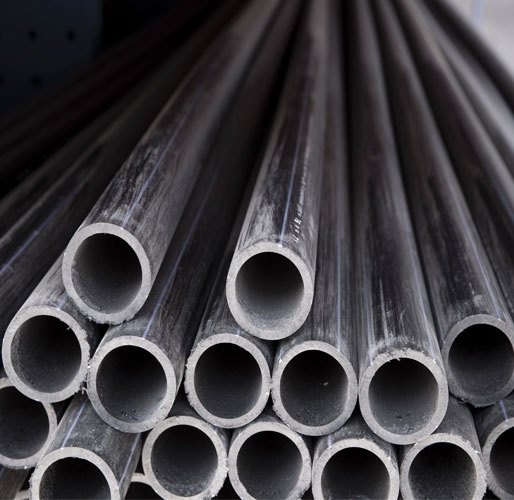
What is ASTM A519 Tube?
ASTM A519 is a standard covering several grades of carbon and alloy steel seamless mechanical tubing. These tubes are manufactured by either hot-finished or cold-finished process for structural or mechanical purposes.
A519 tubing is made for machining or heat treating applications where tight tolerances, a smooth finish, and definite physical properties are important. Steel is cast into ingots or strands and then hot worked. Cold finishing is not required, but it does make tolerances and surface quality better.
A519 tube has precise tolerances, is easy to machine, and comes in heat-treatable grades. It is used widely in manufacturing machinery, automotive parts, hydraulic cylinders, shafts, gears, bushings, and bearings. The seamless construction means there will be no failures under stress due to the absence of a weld.
Types of ASTM A519 Mechanical Tubing
ASTM A519 tubes are classified by manufacturing finish. Two main categories include Hot Finished Seamless (HFS) and Cold Drawn Seamless (CDS). Additional processing options include rough-turning and grinding.
Finished Seamless (HFS) Tubing
HFS tubing is manufactured by hot working steel into a tubular form. The tube is made to the OD and wall thickness dimensions. It is generally furnished in an unannealed condition. Applications include general mechanical and structural purposes where close tolerances are not critical. This is the cost-effective option for larger sizes.
Cold Drawn Seamless (CDS) Tubing
CDS tubing starts as hot finished tube then gets further processed by cold drawing. This provides tighter tolerances on OD, ID and wall thickness. Surface finish is better and mechanical properties improve from the cold working. It is available in annealed or stress-relieved conditions. Applications include precision mechanical components, hydraulic cylinders and bearing surfaces.
Rough-Turned Mechanical Tubing
Rough-turned mechanical tubing is a tube with OD rough-turned on a lathe. This removes surface imperfections and provides machining allowance. This tube is used where final machining is performed to achieve exact dimensions.
Ground Mechanical Tubing
This is a tube with OD precision ground. It provides a tight tolerance and a smooth surface finish. Ground mechanical tubing is used for precision bearing applications and hydraulic piston rods where surface quality is critical.
ASTM A519 Tube Grades
ASTM A519 covers three main grade categories: Low Carbon Steel, Medium-High Carbon Steel and Alloy Steel. Each grade is designated by the SAE/AISI number system based on chemical composition.
1. ASTM A519 Grade 1020 Tube
A519 Grade 1020 tube is a low carbon steel with 0.18-0.23% carbon (UNS G10200). Good weldability and formability make it versatile. Applications include general mechanical and structural tubing and DOM tube manufacturing. It is available in both CDS and HFS finishes.
2. ASTM A519 Grade 1026 Tube
A519 Grade 1026 tube is a medium carbon steel with 0.22–0.28% carbon and more manganese (0.60–0.90%) to make it stronger (UNS G10260). It is often used for DOM tubing, cold drawn seamless, and hot finished seamless applications. It is a popular choice for wall thickness heavier than 0.156" (4mm).
3. ASTM A519 Grade 1045 Tube
A519 Grade 1045 tube is a medium-high carbon steel with 0.43-0.50% carbon (UNS G10450). It is heat treatable for higher strength. Applications include shafts, gears, connecting rods and machine parts that require wear resistance. It is typically supplied in normalised or quenched and tempered conditions.
4. ASTM A519 Grade 4130 Tube (Chromoly)
A519 Grade 4130 tube is a chrome-molybdenum alloy steel and contains 0.28–0.33% C, 0.80–1.10% Cr, and 0.15–0.25% Mo (UNS G41300). It is commonly used for aerospace and racing as it has an excellent strength-to-weight ratio. This grade has good weldability compared to higher carbon grades. It is used for race car roll cages, aircraft structures and hydraulic tubing. It is also referred to as "Chromoly" or "Cromo" in the industry.
5. ASTM A519 Grade 4140 Tube
A519 Grade 4140 tube is a chrome-molybdenum alloy steel with 0.38-0.43% C, 0.80-1.10% Cr, 0.15-0.25% Mo (UNS G41400). Its higher carbon content than 4130 provides increased hardness after heat treatment. It has high fatigue strength, abrasion and impact resistance. This grade is commonly used in high-stress machinery parts like shafts, gears, axles, and spindles. Tensile strength reaches up to 655 MPa (95,000 psi) in a normalised condition.
Other ASTM A519 Grades
- 1010, 1015, 1018: Low carbon grades for easy forming and welding
- 1025, 1030, 1035: Medium carbon grades, heat treatable
- 4142, 4145, 4150: Higher carbon chromoly variants for maximum hardness
- 4340: Nickel-chrome-moly alloy for the highest strength applications
- 8620, 8630: Nickel-chrome-moly grades suitable for case hardening
ASTM A519 Tube Chemical Composition
The following table outlines the ASTM A519 chemical composition requirements for common grades based on heat analysis:
| Element | Grade 1026 | Grade 4130 (Chromoly) |
|---|---|---|
| Carbon (C) | 0.22 - 0.28% | 0.28 - 0.33% |
| Manganese (Mn) | 0.60 - 0.90% | 0.40 - 0.60% |
| Phosphorus (P) | 0.040% max | 0.035% max |
| Sulfur (S) | 0.050% max | 0.040% max |
| Silicon (Si) | - | 0.15 - 0.35% |
| Chromium (Cr) | - | 0.80 - 1.10% |
| Molybdenum (Mo) | - | 0.15 - 0.25% |
ASTM A519 Tube Specifications
The following ASTM A519 tube specifications define the dimensional, mechanical, and manufacturing parameters for ASTM A519 seamless mechanical tubing:
| Specification | ASTM A519 / ASME SA519 |
|---|---|
| Product Name | A519 Mechanical Tubing, A519 Steel Tube |
| Size Range | 1/4" OD to 24" OD |
| Wall Thickness | Schedule 10 through XXS |
| Manufacturing | ASTM A519 Seamless Tube, Drawn-Over-Mandrel (DOM) |
| Finish | Hot-Finished (HF), Cold-Drawn (CD), Annealed, Normalized |
| Grades | Carbon Steel (1010, 1026) & Alloy Steel (4130, 4140, 8620) |
| Certification | Mill Test Certificate (MTC) as per EN 10204 3.1 |
ASTM A519 Tube Size Chart
This size chart presents the standard dimensional ranges available for ASTM A519 round mechanical tubing:
| Nominal Pipe Size (NPS) | Outside Diameter (in) | Wall Thick. (in) | Inside Diameter (in) | Weight (lbs/ft) | Schedule | Section Modulus (in³) | Capacity (gal/ft) |
|---|---|---|---|---|---|---|---|
| 1/2" | 0.840 | 0.109 | 0.622 | 0.85 | 40 / STD | 0.0407 | 0.0158 |
| 0.147 | 0.546 | 1.09 | 80 / XHY | 0.0478 | 0.0122 | ||
| 0.188 | 0.464 | 1.31 | 160 | 0.0528 | 0.0088 | ||
| 0.294 | 0.252 | 1.72 | XXHY | 0.0577 | 0.0026 | ||
| 3/4" | 1.050 | 0.113 | 0.824 | 1.13 | 40 / STD | 0.0705 | 0.0277 |
| 0.154 | 0.742 | 1.48 | 80 / XHY | 0.0853 | 0.0225 | ||
| 0.219 | 0.612 | 1.95 | 160 | 0.1006 | 0.0153 | ||
| 0.308 | 0.434 | 2.44 | XXHY | 0.1103 | 0.0077 | ||
| 1" | 1.315 | 0.133 | 1.049 | 1.68 | 40 / STD | 0.1328 | 0.0449 |
| 0.179 | 0.957 | 2.17 | 80 / XHY | 0.1606 | 0.0374 | ||
| 0.250 | 0.815 | 2.85 | 160 | 0.1904 | 0.0271 | ||
| 0.358 | 0.599 | 3.66 | XXHY | 0.2136 | 0.0146 | ||
| 1 1/4" | 1.660 | 0.140 | 1.380 | 2.27 | 40 / STD | 0.2346 | 0.0777 |
| 0.191 | 1.278 | 3.00 | 80 / XHY | 0.2913 | 0.0666 | ||
| 0.250 | 1.160 | 3.77 | 160 | 0.3421 | 0.0549 | ||
| 1 1/2" | 1.900 | 0.145 | 1.610 | 2.72 | 40 / STD | 0.3262 | 0.1058 |
| 0.200 | 1.500 | 3.63 | 80 / XHY | 0.4118 | 0.0918 | ||
| 0.281 | 1.338 | 4.86 | 160 | 0.5079 | 0.0730 | ||
| 2" | 2.375 | 0.154 | 2.067 | 3.66 | 40 / STD | 0.5606 | 0.1743 |
| 0.218 | 1.939 | 5.03 | 80 / XHY | 0.7309 | 0.1534 | ||
| 0.344 | 1.687 | 7.47 | 160 | 0.9806 | 0.1161 | ||
| 0.436 | 1.503 | 9.04 | XXHY | 1.1043 | 0.0922 | ||
| 2 1/2" | 2.875 | 0.203 | 2.469 | 5.80 | 40 / STD | 1.0640 | 0.2487 |
| 0.276 | 2.323 | 7.67 | 80 / XHY | 1.3386 | 0.2202 | ||
| 0.375 | 2.125 | 10.02 | 160 | 1.6371 | 0.1842 | ||
| 3" | 3.500 | 0.216 | 3.068 | 7.58 | 40 / STD | 1.7241 | 0.3840 |
| 0.300 | 2.900 | 10.26 | 80 / XHY | 2.2253 | 0.3431 | ||
| 0.438 | 2.624 | 14.34 | 160 | 2.8774 | 0.2811 | ||
| 4" | 4.500 | 0.237 | 4.026 | 10.80 | 40 / STD | 3.2145 | 0.6613 |
| 0.337 | 3.826 | 15.00 | 80 / XHY | 4.2713 | 0.5972 | ||
| 0.531 | 3.438 | 22.53 | 160 | 5.8997 | 0.4822 | ||
| 6" | 6.625 | 0.280 | 6.065 | 18.99 | 40 / STD | 8.4958 | 1.5008 |
| 0.432 | 5.761 | 28.60 | 80 / XHY | 12.2240 | 1.3541 | ||
| 0.562 | 5.501 | 36.43 | 120 | 14.9806 | 1.2346 | ||
| 0.719 | 5.187 | 45.39 | 160 | 17.8243 | 1.0977 |
Difference Between ASTM A519 and ASTM A513
The main difference between A519 and A513 is the manufacturing process:
| Aspect | ASTM A519 | ASTM A513 |
|---|---|---|
| Manufacturing | Seamless | Welded (ERW) |
| Process | Hot piercing + cold draw | Electric resistance welded |
| Strength | Higher (no weld seam) | Lower (weld present) |
| Cost | Higher | Lower |
| Typical Use | High-stress mechanical | General mechanical |
Note: A513 Type 5 (DOM - Drawn Over Mandrel) is a welded tube that is cold drawn over a mandrel. This approaches seamless properties but A519 remains preferred for critical, high-stress applications.
Quality Testing & Certification
- Flattening Test: One test from each end of one tube per lot to verify ductility
- Flaring Test: One test from each end of one tube per lot to verify formability
- Hardness Test: Brinell or Rockwell hardness verification per grade and condition
- Tension Test: Yield strength, tensile strength, elongation per ASTM A370
- NDT Testing (Optional): Ultrasonic or Eddy Current testing when specified
- Chemical Analysis: Heat analysis per ASTM A751 specifications
Available certifications:
- EN 10204/3.1B Material Test Certificate (MTC)
- Govt. Lab Test Certificate (NABL Approved)
- Third Party Inspection Report (TPI)
- 100% Ultrasonic / Eddy Current Test Report
- Heat Treatment Certificate
ASTM A519 Mechanical Tubing Applications
ASTM A519 seamless mechanical tubing is used in applications requiring precision dimensions, smooth surfaces and high strength. A519 tube applications are found in the following 7 industries:
Frequently Asked Questions
-
What is ASTM A519 tube used for?ASTM A519 tubes are used for structural and mechanical purposes, such as manufacturing machines, hydraulic cylinders, automotive parts, structures for airplanes and equipment for oil and gas. The seamless construction makes it stronger for high-stress applications where weld failure is not an option.
-
What is the difference between ASTM A519 1020 and 1026?The main difference is the carbon and manganese content. Grade 1026 has higher carbon 0.22-0.28%, while Grade 1020 has 0.18-0.23% carbon. Grade 1026 contains 0.60-0.90% manganese, while Grade 1020 contains 0.30-0.60% manganese. This composition provides improved strength. Grade 1026 is commonly used for heavier wall thickness applications above 4mm (0.156").
-
Is ASTM A519 4130 weldable?Yes, ASTM A519 Grade 4130 (chromoly) can be welded using any of the conventional methods. It has a lower carbon content (0.28–0.33%) than 4140, so it is easy to weld without needing to be extensively preheated. For crucial applications, post-weld heat treatment may be needed to restore the properties in the heat-affected zone.
-
What is the maximum OD for ASTM A519 tubing?ASTM A519 covers round tubing up to 12-3/4 inches (323.8mm) outside diameter. Wall thickness is specified as required per application. Larger sizes may be available on special order from manufacturers with appropriate equipment.
-
What does CDS mean in ASTM A519?CDS stands for Cold Drawn Seamless. This is hot-finished seamless tubing that has been further processed by cold drawing. Cold drawing achieves tighter tolerances on OD, ID and wall thickness, better surface finish and improved mechanical properties compared to hot-finished tubing. CDS is preferred for precision applications.