



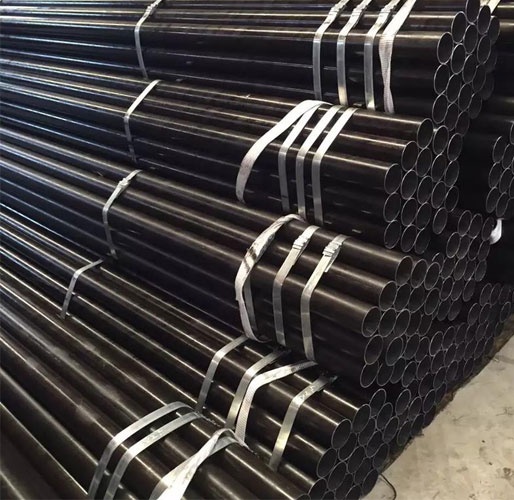
What is Carbon Steel Seamless Tube?
A CS seamless tube is a seamless hollow cylindrical steel product. The production involves piercing a solid billet, followed by hot working or cold drawing processes. The absence of a weld seam provides the tube with uniform strength in all directions. This makes it suitable for high-pressure and high-temperature applications where welded tubes may fail.
The manufacturing process goes as follows: hot piercing of billet → hot rolling or extrusion → cold drawing (for precision tubes) → heat treatment → testing and inspection. Cold-drawn tubes achieve tighter dimensional tolerances and superior surface finish compared to hot-finished variants.
Seamless tubes differ from welded tubes in one critical aspect. They have no weld-related defects. This means no weld porosity, no heat-affected zones and no potential weak points. Applications include boilers, superheaters, heat exchangers, condensers, hydraulic systems, and mechanical components.
Carbon Steel Seamless Tube Standards
The carbon steel seamless tube standards define chemical composition, mechanical properties, testing requirements, and dimensional tolerances. Different standards serve different applications.
ASTM A179 / ASME SA179
ASTM A179 is the standard specification for seamless cold-drawn low-carbon steel heat-exchanger and condenser tubes. It covers minimum-wall-thickness seamless cold-drawn tubes manufactured specifically by the cold-drawing process. Sizes range from 1/8" to 3" (3.2mm to 76.2mm) OD. The standard mandates heat treatment at 650°C minimum after cold drawing. Chemical composition includes Carbon (0.06-0.18%), Manganese (0.27-0.63%). Mechanical requirements of this standard are 325 MPa tensile minimum and 180 MPa yield minimum. Required tests include hardness, flattening, flaring, flange, and hydrostatic. ASTM A179 / ASME SA179 tubes are used in applications like heat exchangers, condensers, and similar heat transfer apparatus.
ASTM A192 / ASME SA192
ASTM A192 is the standard specification for seamless carbon steel boiler tubes for high-pressure service. It covers minimum-wall-thickness seamless boiler and superheater tubes. Size ranges from 1/2" to 7" (12.7mm to 177.8mm) OD. Wall thickness is 0.085" to 1.000" (2.2mm to 25.4mm) minimum. These tubes can be hot or cold worked. Chemical composition matches A179: C 0.06-0.18%, Mn 0.27-0.63%, Si 0.25% max. Mechanical requirements of the ASTM A192 / ASME SA192 standard are 325 MPa tensile minimum and 180 MPa yield minimum. Required tests include flattening, flaring, hardness, and hydrostatic. The tubes under this standard are used in applications like high-pressure boilers, superheaters and water-wall tubes.
ASTM A210 / ASME SA210
ASTM A210 is the standard specification for seamless medium-carbon steel boiler and superheater tubes. It covers medium-carbon steel tubes for boiler applications with higher strength requirements than A192. Two grades are available under this standard: Grade A1 (lower carbon, C 0.27% max, tensile 415 MPa min, yield 255 MPa min) and Grade C (higher strength, C 0.35% max, tensile 485 MPa min, yield 275 MPa min). The size range is from 1/2" to 5" (12.7mm to 127mm) OD. Wall thickness is 0.9mm to 12.7mm. Tube applications under this standard include boilers, superheaters, safe ends, arch tubes, and stay tubes.
ASTM A519 / ASME SA519
ASTM A519 is the standard specification for seamless carbon and alloy steel mechanical tubing. It covers hot-finished and cold-finished mechanical tubing for machining, heat treating, structural, and mechanical purposes. Sizes range is up to 12-3/4" (323.8mm) OD. Multiple grades are available: 1018, 1020, 1026, 1045, 4130, 4140, and others. Delivery conditions include: As-rolled (A), Normalised (N), Quenched & Tempered (QT), and Stress Relieved (SR). Close tolerances and smooth finishes are standard requirements for mechanical tubing applications.
DIN 2391 / EN 10305
DIN 2391 and EN 10305 are European standards for precision seamless steel tubes. EN 10305-1 covers cold-drawn precision tubes for general applications. EN 10305-4 specifically covers tubes for hydraulic and pneumatic systems. Common grades include St35/E235, St45/E275, St52/E355. Size ranges from 4mm to 250mm OD and 0.5mm to 20mm wall thickness. Delivery conditions include +C (BK - as drawn), +N (NBK - normalised). Dimensional tolerances are from IT9 to IT6 for outer diameter. Applications of tubes under the DIN 2391 / EN 10305 standard include hydraulic cylinders, automotive components, and precision machinery.
BS 3059 / IS 1239
BS 3059 Part 2 covers steel boiler and superheater tubes with grades 320, 360, 440, and 620. IS 1239 covers steel tubes for general engineering purposes. IS 3074 covers steel tubes for structural purposes. For boiler applications in India, IBR Certification is mandatory. These standards are widely used in Indian power plants and industrial boilers.
Difference Between Seamless and Welded Tubes
The main difference between seamless and welded tubes is how they are made and how much pressure they can handle. A solid billet is used to make seamless tubes, while a strip is used to make welded tubes, which are then joined by welding.
| Aspect | Seamless Tube | Welded Tube |
|---|---|---|
| Manufacturing | Pierced from solid billet | Formed from strip and welded |
| Weld Seam | None | Longitudinal or spiral |
| Strength | Uniform in all directions | Weld may be weaker |
| Pressure Rating | Higher | Lower to medium |
| Wall Uniformity | Slight variation possible | More consistent |
| Size Range | Limited (up to ~24" OD) | Larger sizes available |
| Cost | Higher | Lower |
| Applications | High-pressure, critical | General, structural |
Seamless tubes are the choice for boilers, high-pressure service, and critical applications. Welded tubes are acceptable for structural uses, low-pressure systems, and large-diameter requirements.
Difference Between Hot Finished and Cold Drawn Tubes
The main difference between hot finished and cold drawn seamless tubes is the processing temperature and the resulting properties. Hot finished tubes are worked above recrystallisation temperature (~1200°C), while cold drawn tubes are processed at room temperature.
| Aspect | Hot Finished | Cold Drawn |
|---|---|---|
| Process Temperature | Above recrystallisation (~1200°C) | Room temperature |
| Surface Finish | Rough, mill scale | Smooth, bright |
| Dimensional Tolerances | Wider | Tighter |
| Mechanical Properties | Lower strength | Higher strength (work hardened) |
| Wall Uniformity | Less consistent | More consistent |
| Size Range | Larger | Limited by drawing capacity |
| Cost | Lower | Higher |
| Applications | Large sizes, general service | Precision, heat exchangers |
Hot finished tubes are cost-effective for larger sizes and general boiler applications. Cold drawn tubes are specified for precision tubes, heat exchangers, and hydraulic systems where dimensional accuracy matters.
Comparison: ASTM A179 vs A192 vs A210
For boilers and heat exchangers, ASTM A179, A192 and A210 are the main standards for seamless carbon steel tubes. You can choose between the three grades based on your application, size requirements, and strength needs.
| Aspect | ASTM A179 | ASTM A192 | ASTM A210 |
|---|---|---|---|
| Application | Heat exchangers, condensers | High-pressure boilers | Boilers, superheaters |
| Carbon Content | 0.06–0.18% (low) | 0.06–0.18% (low) | 0.27–0.35% (medium) |
| Manufacturing | Cold drawn only | Hot or cold worked | Hot or cold worked |
| Size Range (OD) | 3.2–76.2mm | 12.7–177.8mm | 12.7–127mm |
| Tensile Strength | 325 MPa min | 325 MPa min | 415–485 MPa min |
| Heat Treatment | 650°C min after cold draw | None specified | None specified |
| Grades | Single grade | Single grade | Grade A1, Grade C |
| Typical Use | Heat transfer apparatus | Water-wall, boiler tubes | Superheaters, higher strength |
Selection guide: Use A179 for heat exchangers and condensers requiring cold-drawn tubes with the best surface finish. Use A192 for high-pressure boilers that require larger sizes. Use A210 for superheaters and applications that require higher strength.
Carbon Steel Seamless Tube Applications
Carbon steel seamless tubes are used in high-pressure and high-temperature applications requiring superior mechanical integrity. These tubes find applications in the following 7 industries.
Quality Testing & Certification
Each of our carbon steel seamless tubes undergoes mandatory testing as per the ASTM/ASME standards. The following tests verify material quality and dimensional conformance:
- Hydrostatic Test: Each tube is tested at the specified pressure to verify pressure integrity. Alternative: Nondestructive electric test (NDT).
- Flattening Test: Tube section is flattened between parallel plates to detect defects and verify ductility.
- Flaring Test: Tube end is expanded to a specified diameter to verify formability without cracking.
- Flange Test: A 90° flange is formed on the tube end to verify material quality (ASTM A179 optional).
- Hardness Test: Rockwell B or Brinell hardness testing to verify heat treatment. ASTM A179: 72 HRB max, ASTM A192: 77 HRB max.
- Tensile Test: Longitudinal tensile test to determine ultimate tensile strength, yield strength, and elongation.
- Chemical Analysis: Spectrometer analysis for carbon, manganese, silicon, phosphorus, and sulfur content.
- Ultrasonic Testing (UT): 100% non-destructive testing for detection of internal defects when specified.
Available certifications:
- EN 10204 / 3.1B Material Test Certificate (MTC)
- IBR Certification (Indian Boiler Regulations)
- Government Lab Test Certificate (NABL Approved)
- Third Party Inspection Report (TPI – SGS, Bureau Veritas, Lloyds)
- Heat Treatment Certificate
- 100% UT / RT Report (when specified)
Frequently Asked Questions
-
What is the difference between ASTM A179 and ASTM A192 tubes?ASTM A179 is for heat exchanger and condenser tubes. They are manufactured by cold drawing only and sizes range from 3.2 to 76.2mm OD. ASTM A192 is for high-pressure boiler tubes. These tubes can be hot or cold worked, with sizes ranging from 12.7 to 177.8mm OD. Both have the same chemical composition (0.06–0.18% C) and mechanical properties (325 MPa tensile min). However, after cold drawing, A179 must be heat-treated at 650°C.
-
What is the maximum temperature for carbon steel seamless tubes?Carbon steel seamless tubes like ASTM A179, A192, and A210 can be used continuously at temperatures up to about 454°C (850°F). Carbon steel suffers from graphitisation and reduced strength when it gets hotter than this. For higher temperatures, you need alloy steel tubes (ASTM A213 T11, T22, T91) that have additions of chromium and molybdenum.
-
Is IBR certification mandatory for boiler tubes in India?In India, tubes used in steam boilers with a capacity of more than 25 liters and a working pressure of more than 1 kg/cm² must be certified by the Indian Boiler Regulations (IBR). IBR requires materials to be tested by a third party during manufacturing and that they must meet approved standards like ASTM A179, A210, and BS 3059. Non-IBR tubes are only allowed in systems with low pressure that are below these limits.
-
Can carbon steel seamless tubes be used for hydraulic cylinders?Yes, carbon steel seamless tubes are highly suitable for hydraulic cylinders. The DIN 2391 (EN 10305-4) precision tubes with grades St52 (E355) are made specifically for hydraulic and pneumatic power systems. These tubes have tight tolerances, a smooth internal surface (honed or skived and burnished for cylinder barrels), and can handle high pressure. ASTM A519 mechanical tubing is also used for hydraulic applications.