



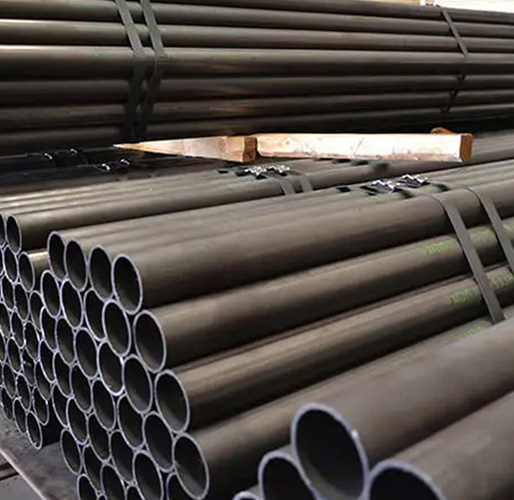
What are Grades 1330/1335?
Grades 1330 and 1335 are manganese alloy steels in the 13XX series with elevated manganese content (1.60-1.90%). These 1330 1335 tubes offer improved hardenability and strength compared to the plain carbon steels with similar carbon content. The higher manganese also provides an economical alternative to more expensive nickel and chromium alloy steels. For applications that require deeper hardening, these tubes provide improved performance over plain carbon 10XX grades.
ASTM A519 GRADE 1330, 1335 Tube Chemical Composition
The table below highlights the 1330 1335 composition comparison as per the ASTM A519 standard. High manganese content distinguishes 13XX from 10XX series:
| Element | Min | Max | Similar |
|---|---|---|---|
| Cu | - | 0.3500 | - |
| Mo | - | 0.1000 | - |
| Ni | - | 0.2500 | - |
| Cr | - | 0.2000 | - |
| P | - | 0.0400 | - |
| S | - | 0.0400 | - |
| Mn | 1.6000 | 1.9000 | - |
| Si | 0.1500 | 0.3500 | - |
| C | 0.2800 | 0.3300 | - |
ASTM A519 GRADE 1330, 1335 Tube Mechanical Properties
Mechanical properties of 1330 and 1335 tubes are explained below. Oil quench and temper produce the best combination of strength and toughness:
|
Yield Rp0.2 (MPa) |
Tensile Rm (MPa) |
Impact KV/Ku (J) |
Elongation A (%) |
Reduction in cross section
on
fracture Z (%) |
As-Heat-Treated Condition | Brinell hardness (HBW) |
|---|---|---|---|---|---|---|
| 791 (≥) | 839 (≥) | 33 | 13 | 24 | Solution and Aging, Annealing, Ausaging, Q+T,etc | 124 |
1330 vs 1030 Series
Comparison of the 13XX manganese series with the 10XX plain carbon series at similar carbon levels is as follows:
| Property | 1330 | 1030 |
|---|---|---|
| Carbon | 0.28–0.33% | 0.28–0.34% |
| Manganese | 1.60–1.90% | 0.60–0.90% |
| Hardenability | Higher | Lower |
| Max Hardness | HRC 38 | HRC 32 |
| Cost | +10–15% | Base |
13XX offers better hardenability for deeper hardening in larger cross-sections.
Heat Treatment
Recommended heat treatment parameters for 1330 and 1335 tubes:
- Normalize: 870–925°C (1600–1700°F)
- Austenitize: 830–870°C (1525–1600°F)
- Quench: Oil (preferred), water for maximum hardness
- Temper: 400–650°C (750–1200°F)
Higher manganese provides better through-hardening in larger cross-sections than 10XX grades.
Applications
The A519 1330 and 1335 tubes serve the following 3 applications requiring improved hardenability over plain carbon grades:
Frequently Asked Questions
-
Why choose 1330/1335 over 4140?
1330 and 1335 are more affordable as they don't have expensive alloying elements like chromium and molybdenum. They are also easier to machine when they are annealed. This speeds up production cycles and lowers tool wear. This further lowers manufacturing costs. Choose 4140 when maximum hardenability or higher strength is required. -
Are 1330/1335 weldable?
Yes, 1330/1335 are weldable with proper procedures. Preheating at 150-260°C (300-500°F) is recommended. Post-weld heat treatment enhances its properties. Low-hydrogen electrodes are essential to prevent hydrogen-induced cold cracking.