



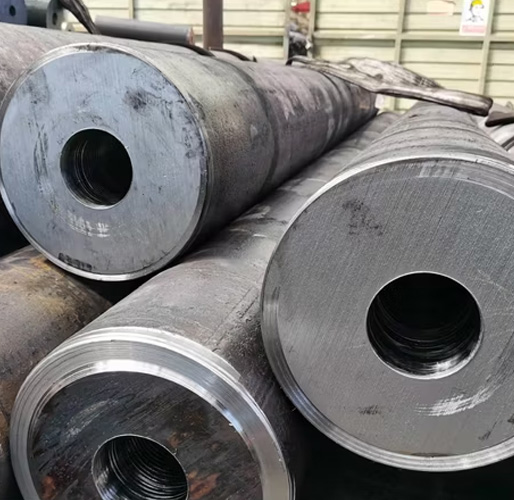
What is an Alloy Steel Hollow Bar?
An alloy steel hollow bar is a seamless tube with a thick wall. It is often used to make shafts or cylinders. We use alloy steel grades like 4140 and 4130 to make these bars because they have better mechanical properties than carbon steel. The hollow construction makes it lighter without compromising its strength. Manufacturers use hollow bars to reduce machining time when making components with central bores. The seamless construction eliminates weld seam concerns in rotating or high-stress applications. These products are also commonly referred to as seamless hollow bar, hollow shaft, and thick-wall seamless tube.
Alloy Steel Hollow Bars Grades Available
AISI 4140 Hollow Bar
4140 hollow bar is a chrome-moly alloy with good hardenability, strength, and toughness. This is our most popular grade for general-purpose applications. It responds well to heat treatment and machines efficiently in annealed condition.
AISI 4130 Hollow Bar
The 4130 hollow bar has lower carbon than 4140. This provides better weldability. Aircraft and motorsport industries prefer this grade where welding is required. The chrome-moly composition still provides good strength and fatigue resistance.
AISI 4340 Hollow Bar
The 4340 hollow bar is a nickel-chrome-moly alloy with the highest strength and toughness. Critical applications like aircraft landing gear and heavy-duty equipment use this grade. It handles severe stress and impact loads where other grades fall short.
EN19/42CrMo4 Hollow Bar
The EN19 hollow bar is the European equivalent to AISI 4140. Machinery builders specify this grade for shafts, spindles, and power transmission components. The proven performance in industrial applications makes EN19 a reliable choice.
Alloy Steel Hollow Bars Specifications
The following hollow bar specifications, like grades, dimensions, standards, etc., outline our product range.
| Material | Alloy Steel |
|---|---|
| Outer Diameter | 10-100mm |
| Wall Thickness | 2-20mm |
| Length | 1-6m |
| Surface Finish | Smooth |
| Standards | ASTM A216 |
| Usage | Structural applications, mechanical components, hydraulic systems, and more |
| Features | High Strength, Corrosion Resistant, Easy Installation, Durable, Precise Finish |
Alloy Steel Hollow Bars Chemical Composition
Chemical composition determines the heat treatment response and mechanical properties of each grade.
| Ni | Fe | Cr | C | Si | Mn | P | S | N |
|---|---|---|---|---|---|---|---|---|
| 8 - 11 | Balance | 18 - 20 | 0.035 max | 0.75 max | 2 max | 0.040 max | 0.030 max | 0.10 - 0.16 |
Alloy Steel Hollow Bars Mechanical Properties
Mechanical properties after heat treatment determine application suitability. Quenched and tempered condition provides the highest strength values.
| Density | 8.0 g/cm3 |
|---|---|
| Melting Point | 1400 °C (2550 °F) |
| Tensile Strength | Psi - 75000 , MPa - 515 |
| Yield Strength (0.2%Offset) | Psi - 30000 , MPa - 205 |
| Elongation | 35 % |
Applications
The alloy steel hollow bar is used in 3 major industrial applications: