



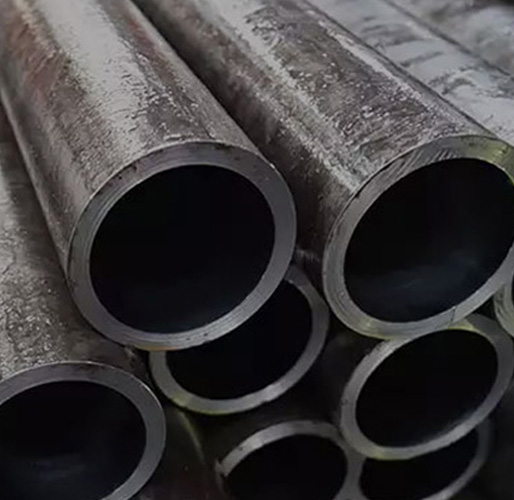
What is the 41XX Series Steel?
The 41XX series steel (4140, 4142, 4145, 4150) is a type of low-alloy steel that contains chromium and molybdenum. It is known for having a consistent amount of Cr-Mo and different amounts of carbon. Since they are very hard, strong, tough, and resistant to fatigue, they are globally used.
The "41" designation indicates: 4 = Molybdenum steel series, 1 = Chromium content, which is approximately 1%, XX = Carbon content (40 = 0.40%, 45 = 0.45%, etc.).
Key characteristics shared by all 41XX grades:
- Chromium: 0.80-1.10% (provides hardenability, wear resistance)
- Molybdenum: 0.15-0.25% (prevents temper brittleness, adds strength)
- Deep hardening capability
- Excellent response to heat treatment
- Good fatigue strength
- Moderate cost compared to nickel alloys
Chemical Composition Comparison of ASTM A519 GRADE 4142, 4145, 4150 Tube
The 4140, 4142, 4145, and 4150 composition differs only in carbon content. This determines maximum achievable hardness and weldability:
| Grade Designation | Chemical Composition Limits, % | |||||||
|---|---|---|---|---|---|---|---|---|
| Carbon | Manganese | Phosphorus max | Sulfur max | Silicon | Nickel | Chromium | Molybdenum | |
| 4142 | 0.40 – 0.45 | 0.75 – 1.00 | 0.04 | 0.04 | 0.15 – 0.35 | – | 0.80 – 1.10 | 0.15 – 0.25 |
| 4145 | 0.43 – 0.48 | 0.75 – 1.00 | 0.04 | 0.04 | 0.15 – 0.35 | – | 0.80 – 1.10 | 0.15 – 0.25 |
| 4150 | 0.48 – 0.53 | 0.75 – 1.00 | 0.04 | 0.04 | 0.15 – 0.35 | – | 0.80 – 1.10 | 0.15 – 0.25 |
Mechanical Properties by Grade
The mechanical properties of 4140, 4145 and 4150 vary with heat treatment conditions:
| Grade | Heat Treatment Condition | Tensile Strength (MPa) | Yield Strength (MPa) | Elongation (%) | Hardness (HB) |
|---|---|---|---|---|---|
| 4140 | Quenched & Tempered | 850 – 1000 | 650 – 850 | 12 – 18 | 197 – 235 |
| 4145 | Quenched & Tempered | 900 – 1100 | 700 – 900 | 10 – 16 | 217 – 255 |
| 4150 | Quenched & Tempered | 950 – 1200 | 750 – 950 | 10 – 15 | 229 – 285 |
4140 vs 4130 Comparison
The 4140 vs 4130 comparison shows key differences in strength and weldability:
| Feature | 4140 | 4130 |
|---|---|---|
| Carbon | 0.38–0.43% | 0.28–0.33% |
| Max hardness | HRC 54–58 | HRC 48–52 |
| Weldability | Good | Excellent |
4130 Advantages: It has better weldability and is used in aerospace structures (aircraft tubing).
4140 Advantages: It provides higher strength and hardness capability, and has better wear resistance. Use 4130 when welding is the primary concern; use 4140 when strength/hardness is the primary concern.
Grade Selection Guide
Choosing 4140 vs 4145 vs 4150 depends on your application requirements:
Choose 4140 when:
General-purpose high-strength applications require a good balance of strength, toughness, and weldability. Target hardness HRC 28-40. Most economical choice in the 41XX series. Applications include hydraulic cylinders, general shafts, and gears.
Choose 4142 when:
Slightly higher strength than 4140 is required with marginally better wear resistance. It has similar applications to 4140, but has higher demands.
Choose 4145 when
High strength and hardness are required (HRC 38-48) with superior wear resistance. Reduced weldability is acceptable. Applications include drill collars, high-load shafts and heavy equipment.
Choose 4150 when:
Maximum hardness is required (HRC 50+) with the highest wear resistance. Welding is not required or carefully controlled. Applications include springs, wear plates, and high-stress components.
Heat Treatment
The 4140 heat treatment and 41XX heat treatment procedures include:
- Normalising: All grades can be annealed at 845-870°C (1550-1600°F), then air-cooled for stress relief and grain refinement.
- Annealing: All grades at 815-870°C (1500-1600°F), furnace cool for maximum machinability.
- Hardening: Austenitise at 830-855°C (1525-1575°F). All grades can be oil quenched. Water quenching provides 4150 with higher hardness but increases the crack risk.
- Tempering: Select temperature based on desired hardness: 200-260°C for maximum hardness, 315-425°C for high strength, 480-595°C for balanced properties, 595-650°C for maximum toughness.
CRITICAL: Avoid tempering at 260-370°C (500-700°F) as it causes temper embrittlement in Cr-Mo steels.
Welding Considerations
4140 welding and welding of higher carbon 41XX grades require careful procedures:
Weldability Ranking (best to worst): 4140 has the highest weldability, followed by 4142 and 4145. 4150 provides the lowest weldability among all the 4 grades.
Preheat Requirements:
4140: 150-260°C (300-500°F)
4142: 175-290°C (350-550°F)
4145: 200-315°C (400-600°F)
4150: 260-345°C (500-650°F)
- Use low-hydrogen electrodes (E8018, E9018, E10018)
- Maintain interpass temperature at preheat level
- Slow cool after welding (wrap in insulating blanket)
- Post-weld heat treatment recommended for critical applications
WARNING: Higher carbon grades (4145, 4150) are susceptible to hydrogen-induced cracking. Careful procedure qualification is essential.
Applications
ASTM A519 4140 tube and related grades serve demanding applications that need high strength and fatigue resistance:
Testing & Certification
All 4140 tube stock and related grades are supplied with complete documentation:
- Mill Test Certificate (MTC): EN 10204/3.1B with full chemical and mechanical verification
- Ultrasonic Testing: For critical applications they detect internal defects
- Hardness Testing: Brinell or Rockwell per specification
- Dimensional Inspection: OD, ID, wall thickness, straightness, ovality
Frequently Asked Questions
-
What is the difference between 4140 and 4145?
4145 has more carbon (0.43–0.48% vs. 0.38–0.43%), which means it is 15% more stronger and harder. 4145 is better for drill collars and heavy-duty applications, while 4140 is better for general mechanical use because it is easier to weld. -
Can 4140 be flame hardened?
Yes, 4140 can be flame and induction hardened. Surface hardness of HRC 50-58 can be achieved with a tough core at HRC 28-32. This is ideal for wear surfaces on shafts and gears while maintaining impact resistance.