



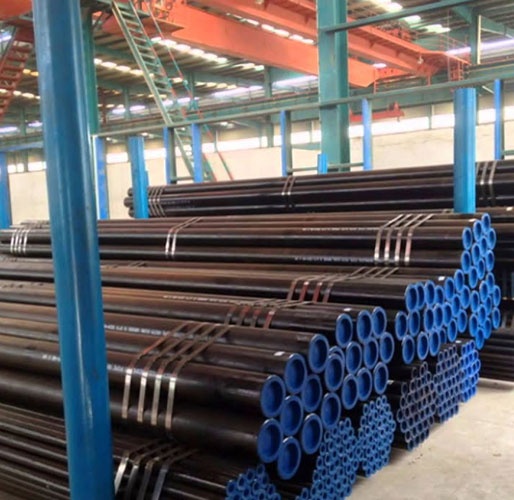
What is ASTM A106 Grade C Pipe?
ASTM A106 Grade C is simply the toughest grade in the ASTM A106 family. It has a 485 MPa minimum tensile strength. People use this grade when they need the most mechanical strength possible for seamless pipes in high-heat areas.
A106 Grade C provides approximately 17% higher tensile strength than Grade B. The extra strength happens because there is more carbon inside. This extra carbon changes how you weld it. Design engineers specify this grade when stress calculations require higher allowable values than Grade B provides.
The pipe goes through the usual tests. Hydrostatic testing and chemical checks prove it meets the rules.
ASTM A106 Grade C Pipe Specifications
ASTM A106 Grade C specifications define the requirements for the highest strength grade of seamless carbon steel pipe for high-temperature service.
| Specifications | ASTM A106 / ASME SA106 Grade C |
|---|---|
| Nominal Pipes Size | 2″ to 24″ O.D. |
| Wall Thickness | SCH10, SCH20, SCH30, STD, SCH40, SCH60, XS, SCH80, SCH100, SCH120, SCH140, SCH160, XXS DIN, JIS standard thickness |
| Coating | 3PE, FBE, Black, Varnished |
| Length | 20 ft (6M), 40 ft (12M), Single Random, Double Random & Cut Length. |
| Sizes | 1/2" NB - 36" NB |
| Pipes Ends | Plain End, Beveled End, Threaded end pipe |
For complete specification requirements, refer to ASTM A106/A106M standard document.
Chemical Composition of ASTM A106 Grade C Pipe
A106 Grade C composition features higher carbon content than Grade B, providing increased strength while requiring more careful welding procedures.
| Element | C % | Mn % | P % Max | S % Max | Si % | Cr % | Cu % Max | Mo % | Ni % | V % Max |
|---|---|---|---|---|---|---|---|---|---|---|
| ASTM A106 / C | 0.35 Max | 0.29–1.06 | 0.025 | 0.025 | 0.10 Min | 0.40 Max | 0.40 | 0.15 Max | 0.40 | 0.08 |
For complete chemical composition requirements, refer to ASTM A106/A106M specification.
Mechanical Properties of ASTM A106 Grade C Pipes
ASTM A106 Grade C delivers the highest mechanical properties within the A106 family.
| Grade | Tensile Strength (Mpa), Min. | Yield Strength (Mpa), Min. |
|---|---|---|
| C | 485 | 275 |
For complete mechanical properties data, refer to ASTM A106/A106M specification.
Applications of ASTM A106 Gr C Pipe
ASTM A106 Gr C is used in 2 major piping systems. The strength is worth the extra effort needed for welding.
Welding Considerations
Due to higher carbon content (0.35% max), ASTM A106 Grade C requires special welding precautions to prevent cracking:
- Preheat for wall thickness over 1/2" (12.7 mm)
- Controlled interpass temperature
- Post-weld heat treatment may be required
- Low hydrogen electrodes recommended
Consult qualified welding engineers for specific procedures based on pipe size, wall thickness, and service conditions.
Frequently Asked Questions
-
When should I use Grade C instead of Grade B?
Use ASTM A106 Grade C when design calculations require higher allowable stress than Grade B provides. Grade C offers 17% higher tensile strength (485 MPa vs 415 MPa). This allows smaller pipe sizes or thinner walls while maintaining required safety factors. Consider the additional welding requirements when evaluating Grade C for your application. -
Can A106 Grade B be welded?
Yes, ASTM A106 Grade B is easy to weld as it has a controlled amount of carbon. If the wall is thicker than 3/4" (19mm), preheating might be a good idea depending on the carbon equivalent value. For most uses, standard welding methods with low-hydrogen electrodes make good welds.