



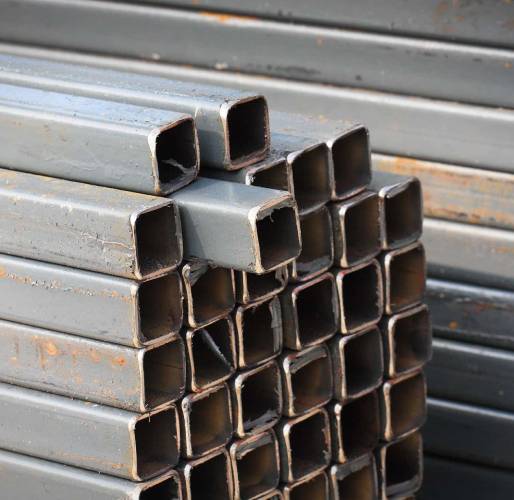
What is MS Hollow Pipe?
An MS hollow pipe is a round pipe made from mild steel. It is also known as CHS or a structural pipe. These are pipes with a circular cross-section. They are designed to hold up weight in a building.
Hollow pipe is for structural load-bearing applications. This makes it different from regular pipe. Regular pipe moves liquids and gases. For hollow pipes, the way the shape resists bending and twisting is what matters. Pressure ratings are secondary.
We make most mild steel hollow pipe products using Electric Resistance Welding. We take a steel strip and roll it into a circle. Then we weld it along the side. The weld is heat treated so it is as strong as the rest of the metal. We also supply seamless hollow sections for very difficult jobs.
Properties & Features of MS Hollow Pipe
There are 4 main reasons to choose MS hollow pipes:
- High Strength-to-Weight Ratio: The hollow shape means the metal sits away from the centre where it works hardest. This saves on steel tonnage. It makes the whole structure lighter.
- Uniform Structural Properties: The shape is the same in every direction. This makes designing buildings simpler. You do not have to worry about a weak side. There is a big difference between these and I-beams.
- Good Torsional Resistance: A closed pipe resists warping better than an open beam. This is vital for handrails and machine frames.
- Aesthetic Appeal: The rounded look fits modern architecture. There are no sharp edges to catch dirt. Paint stays on the smooth surface well.
Mild Steel Hollow Pipe Applications
MS hollow pipes serve structural applications across construction, machinery and general engineering:
100% Certified Testing & Documentation
- IS 4923 / EN 10219 Compliance verification
- Mill Test Certificate (EN 10204/3.1B)
- Mechanical Test Report (tensile, yield, elongation)
- Dimensional Inspection (OD, wall, length, straightness)
Frequently Asked Questions
-
What is the difference between hollow pipe and regular pipe?
Hollow pipe is for holding up structures. It has very tight size limits. Regular pipe is for moving water or gas. It cares about pressure. The wall thickness for hollow pipes is picked for strength calculations. -
What grade should I use for structural applications?
Most people use YSt 310 or S355JRH in India. These are strong enough for heavy loads. YSt 240 is for lighter jobs. You must check with your engineer. -
Can MS hollow pipe be galvanized?
Yes, we can hot-dip these pipes in zinc to stop rust. You need to drill vent holes so the zinc flows through. Pre-galvanised options exist too. Hot-dipping the finished part covers the weld edges best.