



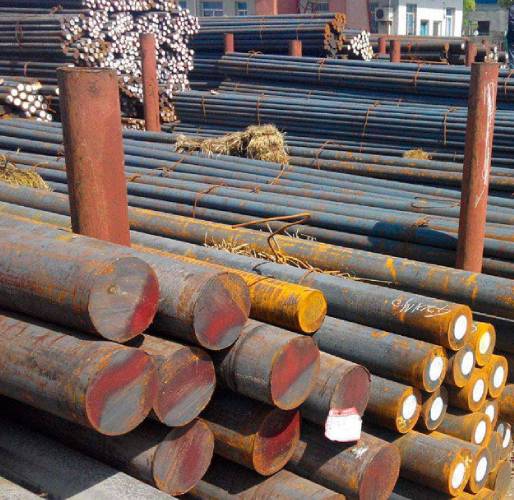
What is a Carbon Steel Round Bar?
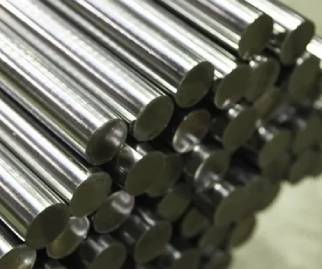
A carbon steel round bar is a solid cylindrical metal bar made primarily of iron and carbon. Trace amounts of manganese, silicon, and sulfur are also present. These bars serve as raw material for machining, forging, fabrication, and manufacturing of components like shafts, pins, bolts, and machine parts.
The bar's properties depend on its carbon content. Mild steel, or low-carbon steel, has between 0.05% and 0.25% carbon. It is easy to weld and shape, but it can't be heat-treated. Medium carbon steel contains 0.25% to 0.60% carbon. This makes it stronger and easier to heat treat. High carbon steel has between 0.60% and 1.00% carbon. It is hard and resistant to wear, but it is hard to weld.
Carbon steel round bars are versatile, machinable, and cost-effective compared to alloy steels. Weldability depends on grade. They find applications in automotive parts, machinery components, construction, tooling and general engineering across industries.
Types of Carbon Steel Round Bar
There are different types of carbon steel round bars depending on the manufacturing process and surface finish. The two main types are hot rolled and cold drawn. Each type is suitable for a different use, depending on how much tolerance and surface quality are needed.
Carbon Steel Round Bar Manufacturing Process
The round bar manufacturing process varies by type:
-
Hot Rolled Round Bar
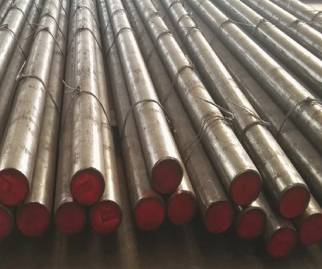
The first step in making hot-rolled round bars is preparing the billets or blooms. Then, they are heated to 1200°C. The heated material goes through a roughing mill, an intermediate mill, and a finishing mill for progressive reduction. After being sized, the bars go to a cooling bed. There, they are straightened and cut to the required length. The process concludes with inspection and marking.
-
Cold Drawn Round Bar
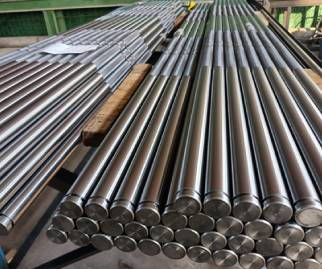
The first step in making cold-drawn round bars is picking out the hot-rolled bars. Pickling is done to get rid of surface scale, and then pointing is done to reduce the leading end. Then, the prepared bars are cold-drawn through a die to get the exact size they need to be. After that, the bars are straightened, cut to size, and checked. You can choose to polish the surface to make it look better.
-
Peeled Round Bar
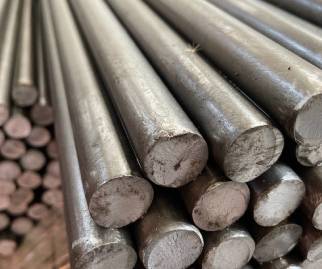
The production of peeled round bars begins with hot-rolled bars that undergo turning or peeling to remove surface defects and achieve accurate dimensions. The bars are then straightened and polished before dimensional inspection and marking.
-
Centreless Ground Bar
Cold-drawn or peeled bars are used as the starting material for making this bar. To get tight tolerances and a better surface finish, these bars are ground in a centerless machine multiple times. Final inspection and packaging are the last steps in the process.
Difference Between Hot Rolled and Cold Drawn Round Bar
The main difference between hot-rolled and cold-drawn round bar lies in the manufacturing temperature and resulting properties:
| Aspect | Hot Rolled | Cold Drawn |
|---|---|---|
| Process Temperature | Above 1200°C | Room temperature |
| Surface Finish | Rough, blue-grey scale (black) | Smooth, bright |
| Tolerances | Wider (h11) | Tighter (h9) |
| Strength | Lower | Higher (work hardened) |
| Cost | Lower | Higher |
| Applications | Structural, general fabrication | Precision machining, shafts |
Comparison: EN8 vs C45 vs SAE 1045
EN8, C45, and SAE 1045 are equivalent medium carbon steel grades from different standards:
| Aspect | EN8 (080M40) | C45 (1.0503) | SAE 1045 |
|---|---|---|---|
| Standard | BS 970 | DIN / EN 10083 | SAE / AISI |
| Carbon % | 0.36 – 0.44 | 0.42 – 0.50 | 0.43 – 0.50 |
| Tensile Strength (Normalized) | 550 – 700 MPa | 570 – 700 MPa | 570 – 700 MPa |
| Common Use | UK / India standard | European standard | US standard |
Carbon Steel Round Bar Specifications
The following specifications define the complete range of carbon steel round bars available in our product line:
| Grade | Carbon Steel |
|---|---|
| Carbon Steel Square bar size | 4 to 100mm |
| CS Hollow Bar | 32mm OD x 16mm ID to 250mm OD x 200mm ID) |
| Low Carbon Steel Hex Bar size | 2-100mm A/F |
| Carbon Steel Angle bar size | 3mm*20mm*20mm~12mm*100mm*100mm |
| CS Rectangles Size | 33 x 30mm to 295 x 1066mm |
| Low Carbon Steel Flat bar size | Thickness: 2 -100mm |
| Width: 10 to 500mm | |
| Carbon Steel Channel Bar | 80 x 40mm to 150 x 75mm section; 5.0 to 6.0mm thickness |
| CS Section | 3.0 to 12.0mm thickness |
| Low Carbon Steel Round bar size | Diameter: 3-~800mm |
| Carbon Steel Billet Size | 1/2" to 495mm Diameter |
| CS Round Bar Standard Dimensions |
Diameter / Height: Carbon Steel Rod and Bar Sizes : 0.5 inches / 0.625 inches / 0.75 inches / 0.875 inches / 1.0 inches / 1.125 inches / 1.25 inches / 1.375 inches / 1.5 inches / 1.75 inches / 2.0 inches / 2.25 inches / 2.5 inches / 2.75 inches / 3.0 inches / 3.25 inches / 3.5 inches / 3.75 inches / 4.0 inches / 4.25 inches / 4.5 inches / 5.0 inches / 5.25 inches / 5.5 inches / 6.0 inches / 7.0 inches / 8.0 inches / 9.0 inches. |
| Carbon Steel Surface | Bright, Hot Rolled Pickled, Cold Drawn, Sand Blasting Finished, Polished, Hairline |
| CS Tolerance | H8, H9, H10, H11, H12, H13K9, K10, K11, K12 or as per clients’ requirements |
| Low Carbon Steel Technique | Carbon Steel Hot Rolled, Cold Drawn, Cold Rolled, Forged Round Bar, Rod |
| Carbon Steel Condition | Hardened & tempered, annealed |
| Finish | Cold (bright) drawn, centreless ground, hot rolled, smooth turned, peeled, slit rolled edge, hot rolled annealed, Rough Turned, Bright, Polish, Grinding, Centreless Ground & Black |
| Form | Carbon Steel Round, Rod, T-Bar, Channel Bar, Precision Ground Bar, Flat Bar, Square Bar, Blocks, Round Rod, Rings, Hollow, Triangle, Rectangle, Hex (A/F), Threaded, Half Round Bar, Profiles, Billet, Ingot, I/H Bar, Forging etc. |
| Processing | Bar cutting to 650mm |
Carbon Steel Round Bar Grades
Carbon steel round bar grades are classified based on carbon content and intended application. The grade determines strength, hardness, machinability and weldability.
Low Carbon Steel Grades (Mild Steel)
Its carbon content is 0.05% to 0.25%. Grades include ASTM A36, IS 2062, SAE 1018, SAE 1020, EN3B, and C20. These round bars made of mild steel are easy to weld and shape, but they aren't as strong (400–500 MPa tensile). They cannot be effectively hardened by heat treatment. Use for general fabrication, welded structures, bolts, brackets, and pins where weldability is more important than strength.
Medium Carbon Steel Grades
The carbon content is 0.25% to 0.60%. Grades include SAE 1045, C45, CK45, EN8, EN8D, EN9. Higher strength (570-700 MPa normalised), heat treatable, fair weldability requiring preheat. Can be induction hardened for wear resistance. Use for shafts, gears, axles, studs, machine parts and automotive components requiring strength and wear resistance.
High Carbon Steel Grades
Carbon content is 0.60% to 1.00%. Grades include SAE 1060, SAE 1080, EN43, and EN47. High hardness and wear resistance, but difficult to weld. Requires careful heat treatment. Use for springs, cutting tools, dies and wear parts.
Free Cutting Steel Grades
Grades include EN1A (230M07), EN1A Leaded, and SAE 12L14. These contain sulfur and/or lead for improved machinability. Excellent surface finish during machining operations. Use for high-volume machined parts, screw machine products and turned components.
Forging Quality Grades
Grades include ASTM A105, ASTM A350 LF2. Designed for forging into flanges, fittings and valves. Good for ambient and low-temperature service. Use for piping components, flanges and pressure vessel parts.
Properties & Features of Carbon Steel Pipes

High Tensile Strength
These pipes handle heavy loads. Strength goes from 315 to 550 MPa.

Excellent Weldability:
You can weld them easily. We suggest TIG or MIG. Low carbon types don't even need pre-heating.

Cost-Effectiveness
It is more affordable than stainless. You get great performance for the price.

High Temperature Resistance
ASTM A106 works up to 400°C. It stays solid when things get hot.
Carbon Steel Round Bar Applications
Carbon steel round bars are widely used in the following 7 engineering and manufacturing applications:
Quality Testing & Certification
- Chemical Analysis: Spectrometer analysis for carbon, manganese, silicon, phosphorus, sulfur content
- Tensile Test: Testing yield strength, tensile strength, elongation as per ASTM E8/A370
- Hardness Test: Brinell (HB) or Rockwell (HRC) hardness measurement
- Ultrasonic Testing (UT): Internal defects detection for critical applications
- Magnetic Particle Inspection: Surface and near-surface defect detection
- Dimensional Inspection: Diameter, length, straightness, ovality verification
Available certifications:
- EN 10204/3.1B Material Test Certificate (MTC)
- Govt. Lab Test Certificate (NABL Approved)
- Third Party Inspection Report (TPI)
- Heat Treatment Certificate
- 100% UT Report (when specified)
Frequently Asked Questions
-
What is the difference between mild steel and carbon steel round bars?
Mild steel is a type of carbon steel with low carbon content (typically 0.05% to 0.25%). The terms are often used interchangeably for low-carbon grades. Carbon steel comprises low, medium and high carbon varieties. Mild steel (like ASTM A36, IS 2062) offers excellent weldability but lower strength compared to medium carbon grades (EN8, 1045). -
What is the EN8 round bar equivalent material?
EN8 (BS 970 080M40) is equivalent to: AISI/SAE 1040, DIN C40/CK40, JIS S40C, and IS 40C8. -
Can a carbon steel round bar be welded?
Yes, but the amount of carbon in the metal affects how well it can be welded. You don't need to heat up A36, 1018, or 1020 before welding them. Medium carbon grades (EN8, 1045, and C45) need to be preheated to 150–300°C and then cooled slowly to keep from cracking. It is not recommended to weld high-carbon grades because they don't weld well. -
What is the maximum diameter available for a bright bar?
Cold-drawn bright bars are typically available up to 150mm in diameter. Peeled and polished bars are suitable for bigger sizes (150mm–300mm+). Hot-rolled bars with machining are the standard choice for diameters over 300 mm. -
What is the hardness of the EN8 round bar after heat treatment?
EN8 can achieve 55-60 HRC surface hardness through induction or flame hardening. For through-hardening by quenching and tempering, EN8 achieves 201-255 HB (approximately 22-27 HRC). Core hardness depends on section size due to the limited hardenability of plain carbon steel.